
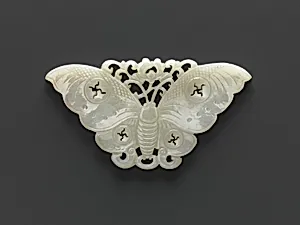
Butterfly
Unknown Artist
18th century
Medium
Jade (nephrite)
Dimensions
H. 4 1/4 in. (10.8 cm); W. 2 5/16 in. (5.8 cm); D. 1/4 in. (0.6 cm)
Classification
Jade
Culture & Period
China · Qing dynasty (1644–1911)
Department
Asian Art
Museum
Metropolitan Museum of Art, New York, NY
Credit
Gift of Heber R. Bishop, 1902
Accession Number
02.18.436
Rights
Public Domain
Tags
Art Historical Context
This exquisite jade butterfly, carved from nephrite during China's Qing dynasty (1644–1911) in the 18th, exemplifies the era's mastery of jade craftsmanship. Measuring just 4¼ inches high, 2⅜ inches wide, and a mere ¼ inch thick, this delicate sculpture captures the insect's graceful wings in stunning detail. Nephrite jade, prized for its toughness and luminous green hue, was a favored material among Chinese artisans, allowing for intricate carving without fracturing. In Qing imperial workshops, jade objects like this one symbolized elegance and harmony, often used as pendants, ornaments, or scholar's accessories. Butterflies held deep cultural resonance in China, evoking joy, marital bliss, and transformation—echoing the fleeting beauty of life. The thin, flat profile suggests it may have adorned a belt or robe, blending functionality with artistry. A generous gift from Heber R. Bishop in 1902, this piece now graces the Metropolitan Museum of Art's Asian Art collection, inviting visitors to marvel at the anonymous sculptor's precision and the enduring allure of Qing jade traditions.