
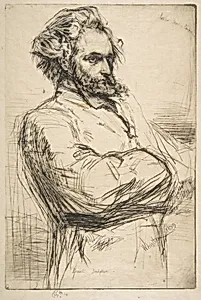
C. L. Drouet, Sculptor
Medium
Etching and drypoint; second state of two (Glasgow); printed in black ink on fine laid ivory Japan
Dimensions
plate: 8 7/8 x 6 in. (22.5 x 15.2 cm) sheet: 14 1/16 x 9 1/2 in. (35.7 x 24.1 cm)
Classification
Prints
Department
Drawings and Prints
Museum
Metropolitan Museum of Art, New York, NY
Credit
Gift of Harold K. Hochschild, 1940
Accession Number
40.63.5
Rights
Public Domain
Tags
Art Historical Context
This 1859 etching drypoint by James McNeill Whistler captures a portrait of the sculptor Charles L. Drouet. Created early in Whistler’s career while he was active in Europe, the print reflects the artist’s growing interest in the expressive possibilities of graphic media. The second state of two reveals his meticulous approach, as he refined lines and tones through additional drypoint work to achieve greater depth and character in the sitter’s features. Printed in black ink on fine laid ivory Japan paper, the work demonstrates the subtle qualities of etching and drypoint. These techniques allow for delicate, velvety lines and rich contrasts that suit intimate portraiture, while the choice of Japan paper enhances the softness and clarity of the impression. At roughly 9 by 6 inches in the plate, the modest scale encourages close viewing and highlights Whistler’s command of detail. Now part of the Metropolitan Museum’s collection of prints, this piece offers insight into mid-nineteenth-century artistic circles, where painters and sculptors often portrayed one another. It stands as a fine example of Whistler’s early printmaking, blending technical precision with a sensitive rendering of personality.
About the Artist
James McNeill Whistler|Charles L. Drouet · 1834–1903
James Abbott McNeill Whistler (1834-1903) was an American-born painter and printmaker who became a leading figure in the Aesthetic Movement and pioneer of Tonalism and Japonisme. He revolutionized art by championing "art for art's sake" and treating paintings as visual equivalents of musical compositions, titling works as "arrangements," "harmonies," and "nocturnes" to emphasize formal qualities o...