
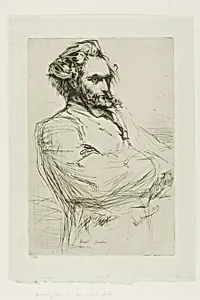
C. L. Drouet, Sculptor
Medium
Etching and drypoint in black ink on light green laid paper
Dimensions
Plate: 22.6 × 15.2 cm (8 15/16 × 6 in.); Sheet: 27.7 × 19.4 cm (10 15/16 × 7 11/16 in.)
Classification
etching
Department
Prints and Drawings
Museum
Art Institute of Chicago
Accession Number
109204
Rights
Public Domain
Art Historical Context
This striking portrait etching captures the likeness of C. L. Drouet, a sculptor and contemporary of the artist, rendered with remarkable sensitivity in 1859. Created by James McNeill Whistler early in his career while based in Paris, the work reflects the young artist’s growing mastery of printmaking as a means of intimate character study. The choice of etching and drypoint allowed Whistler to achieve both crisp linear definition and soft, velvety textures, particularly in the rendering of hair and clothing. Printed in black ink on light green laid paper, the sheet’s subtle tone lends a delicate warmth to the image, softening the contrast and enhancing its atmospheric quality. At just over nine inches tall, the plate size invites close viewing, rewarding the observer with fine details that reveal Whistler’s careful observation and technical precision. As part of the Art Institute of Chicago’s renowned prints and drawings collection, this work exemplifies the nineteenth-century revival of etching as a serious artistic medium. Whistler’s early experiments with the technique would later influence generations of printmakers, demonstrating how a modest portrait could convey both personal connection and artistic innovation.
About the Artist
James McNeill Whistler · 1834–1903
James Abbott McNeill Whistler (1834-1903) was an American-born painter and printmaker who became a leading figure in the Aesthetic Movement and pioneer of Tonalism and Japonisme. He revolutionized art by championing "art for art's sake" and treating paintings as visual equivalents of musical compositions, titling works as "arrangements," "harmonies," and "nocturnes" to emphasize formal qualities o...