
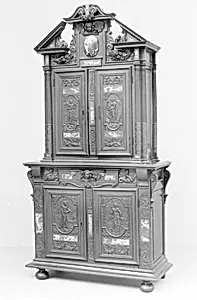
Cabinet
Unknown Artist
second half 16th century with later alterations
Medium
Walnut, marble
Dimensions
86 × 42 in. (218.4 × 106.7 cm)
Classification
Woodwork-Furniture
Culture
French
Department
European Sculpture and Decorative Arts
Museum
Metropolitan Museum of Art, New York, NY
Credit
Rogers Fund, 1906
Accession Number
06.147a, b
Rights
Public Domain
Art Historical Context
Step into the grandeur of Renaissance France with this remarkable *Cabinet*, crafted in the second half of the 16 century and later enhanced with alterations. Standing an impressive 86 inches tall, this piece is fashioned from richly grained walnut—a favored wood for its durability and elegant figuring—accented by luxurious marble elements. As a prime example of French woodwork furniture, it exemplifies the era's fusion of functionality and opulence, serving as both a storage solution for precious objects and a display of refined taste. Originating during the late Renaissance, when French decorative arts flourished under royal patronage, this cabinet reflects the period's emphasis on symmetry, classical motifs, and lavish materials. Walnut's warm tones and workability allowed artisans to showcase intricate joinery and carving techniques, while marble added a cool, monumental contrast, evoking the stone architecture of the time. Such pieces were status symbols in noble households, housing jewels, manuscripts, or curios from expanding European trade routes. Acquired through the Rogers Fund in 1906 and now housed in The Metropolitan Museum of Art's Department of European Sculpture and Decorative Arts, this cabinet invites visitors to ponder the anonymous craftsperson's skill and the enduring allure of 16th-century design. Its survival through centuries underscores the timeless appeal of French Renaissance furniture.