
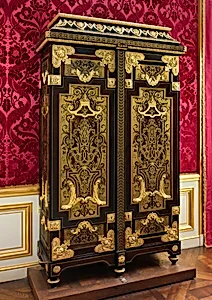
Cabinet
ca. 1700
Medium
Oak veneered with Macassar and Gabon ebony, ebonized fruitwood, burl wood, and marquetry of tortoiseshell and brass; gilt bronze
Dimensions
91-3/4 x 48 x 19 in. (233.0 x 121.9 x 48.3 cm)
Classification
Woodwork-Furniture
Culture
French, Paris
Department
European Sculpture and Decorative Arts
Museum
Metropolitan Museum of Art, New York, NY
Credit
Fletcher Fund, 1959
Accession Number
59.108
Rights
Public Domain
Art Historical Context
Step into the grandeur of Louis XIV's Versailles with this magnificent *Cabinet* by André Charles Boulle, around 1700 in Paris. nearly eight feet tall, this oak-veneered masterpiece showcases Boulle's signature opulence, using exotic Macassar and Gabon ebony, ebonized fruitwood, woods, and intricate gilt-bronze mounts. As the preeminent cabinetmaker to the Sun King, Boulle supplied furniture to the royal palaces, embodying the lavish Baroque style of the French court. At its heart is Boulle's revolutionary *boullework* marquetry, where thin sheets of tortoiseshell and brass are cut together and inlaid into the wood for shimmering, symmetrical patterns—often called *première partie* (with brass prominent) or *contre-partie* (tortoiseshell forward). This labor-intensive technique, blending organic and metallic elements, highlighted technical virtuosity and access to rare materials from global trade. Acquired by The Metropolitan Museum of Art in 1959 through the Fletcher Fund, this cabinet exemplifies the pinnacle of 18th-century French decorative arts. It wasn't just furniture; it was a status symbol for the elite, storing treasures while dazzling onlookers with its intricate craftsmanship and regal presence. A true jewel of European woodwork!