
Cabinet
1663–1747
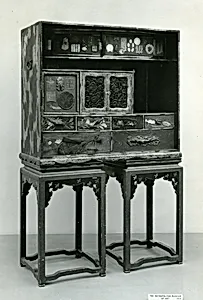
Medium
Lacquered wood
Dimensions
Cabinet and stools: H. 66 3/4 in. (169.5 cm); W. 41 1/4 in. (104.8 cm); D. 19 1/2 in. (49.5 cm) Cabinet: H. 36 1/4 in. (92.1 cm); W. 41 1/4 in. (104.8 cm); D. 9 1/2 in. (49.5 cm) Each stool: H. 30 1/2 in. (77.5 cm); W. 18 1/2 in. (47 cm); D. 8 1/2 in. (47 cm)
Classification
Furniture
Culture
Japan
Department
Asian Art
Museum
Metropolitan Museum of Art, New York, NY
Credit
H. O. Havemeyer Collection, Bequest of Mrs. H. O. Havemeyer, 1929
Accession Number
29.100.68a–c
Rights
Public Domain
Tags
Art Historical Context
This elegant lacquered wood cabinet with matching stools was created by the innovative Japanese artist Ogawa Haritsu, known as Ritsuō (1663–1747). Active during Japan’s Edo period, Haritsu specialized in lacquerware that elevated everyday furniture into refined works of art. His pieces often graced the homes of the merchant and samurai classes, blending practicality with sophisticated decoration. Haritsu pioneered distinctive techniques that set his work apart, including the use of inlaid materials and poetic inscriptions that gave his lacquer surfaces a layered, almost sculptural quality. The rich, glossy finish on this cabinet not only protected the wood but also showcased the luminous depth characteristic of Japanese lacquer traditions. Such furniture served both storage and display purposes, reflecting the period’s emphasis on harmonious interiors. Now part of the Metropolitan Museum of Art’s Asian Art collection through the 1929 Havemeyer bequest, the piece offers visitors a glimpse into the refined craftsmanship and cultural values of 18th-century Japan.