
Cabinet Design with Central Shelves
19th century
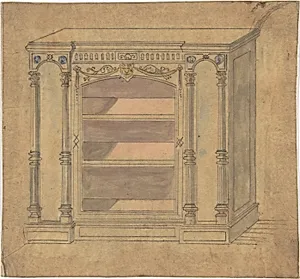
Medium
Graphite and watercolor on tracing paper
Dimensions
sheet: 4 13/16 x 5 1/8 in. (12.2 x 13 cm)
Classification
Drawings|Ornament & Architecture
Department
Drawings and Prints
Museum
Metropolitan Museum of Art, New York, NY
Credit
The Elisha Whittelsey Collection, The Elisha Whittelsey Fund, 1959
Accession Number
59.608.70(41)
Rights
Public Domain
Tags
Art Historical Context
This delicate 19th-century design drawing captures a practical yet elegant vision for a cabinet featuring prominent central shelves. Created by an anonymous British artist, the work reflects the period’s growing emphasis on furniture as both functional household objects and expressions of refined taste. During the Victorian era, such designs helped shape the domestic interiors of an expanding middle class, blending utility with decorative appeal. The choice of graphite and watercolor on tracing paper is especially telling. This medium allowed designers to sketch precise outlines and then layer subtle color washes to suggest wood tones, finishes, or upholstery—techniques essential for communicating ideas to cabinetmakers and clients. The small scale of the sheet, roughly five inches across, suggests it was part of a larger portfolio of ornamental studies rather than a finished presentation piece. Acquired by the Metropolitan Museum in 1959 as part of the Elisha Whittelsey Collection, the drawing offers today’s visitors a rare glimpse into the collaborative, behind-the-scenes process of 19th-century furniture design. Though the artist remains unknown, the work stands as a quiet testament to the careful planning that preceded the ornate cabinets found in Victorian homes.
About the Artist
Anonymous, British, 19th century · 1800–1900
**Anonymous, British, 19th century** is not the name of a single individual but a standard museum attribution used for works whose creators remain unidentified yet are clearly British and date to the 1800s. Major institutions, including the Metropolitan Museum of Art, employ this designation for hundreds of drawings, prints, designs, and decorative studies that lack signatures or firm documentary ...