
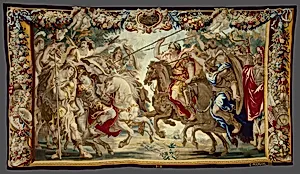
Caesar Defeats the Troops of Pompey from The Story Caesar and Cleopatra
c. 1680
Medium
Wool and silk, slit and double interlocking tapestry weave Warp: Count: 8 warps per cm; wool: S-ply of three Z-spun elements; diameters: 0.7–1.0 mm Weft: Count: varies from 22 to 44 wefts per cm; wool: S-ply of two Z-spun elements; diameters: 0.4–0.9 mm; silk: pairs and three yarns of S-ply of two Z-twisted elements; diameters: 0.6–0.9 mm
Dimensions
673.5 × 370.2 cm (265 1/8 × 145 3/4 in.)
Classification
weaving - tapestry
Department
Textiles
Museum
Art Institute of Chicago
Accession Number
151038
Rights
Public Domain
Art Historical Context
Step into the dramatic world of ancient Rome with *Caesar Defeats Troops of Pompey*, monumental tapestry from the Workshop of Gerard Peemans, around 1680. This piece is part of the lavish series *The Story of Caesar and Cleopatra*, capturing the pivotal Battle of Pharsalus in 48 BCE, where Julius Caesar triumphed over Pompey the Great. Produced in Brussels during the Baroque era, Flemish workshops like Peemans' were renowned for weaving grand historical narratives that adorned the palaces of European nobility, blending classical antiquity with 17th-century opulence. Crafted in wool and silk using slit and double interlocking tapestry weave, the artwork showcases exquisite technical mastery. With 8 warps per cm and varying weft densities up to 44 per cm, the fine S-ply yarns create vibrant, seamless imagery on a massive scale—over 6.7 meters tall and 3.7 meters wide. Silk highlights add luminous depth to figures and battles, while interlocking techniques ensured durability for these wall-hangings, which served as both insulation and status symbols. At the Art Institute of Chicago's Textiles Department, this tapestry exemplifies the golden age of Flemish weaving, a craft that fused artistry with storytelling. It invites visitors to ponder how such epic scenes reinforced ideals of power and heroism for audiences centuries ago.