
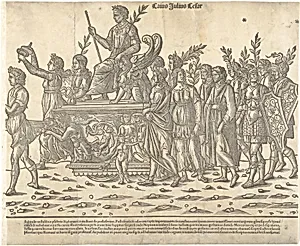
Caesar riding on his chariot, from 'The Triumph of Caesar'
Medium
Woodcut
Dimensions
Height: 13 5/16 in. (33.8 cm) Width: 15 15/16 in. (40.5 cm)
Classification
Prints
Department
Drawings and Prints
Museum
Metropolitan Museum of Art, New York, NY
Credit
Harris Brisbane Dick Fund, 1927
Accession Number
27.54.124
Rights
Public Domain
Tags
Art Historical Context
Behold *Caesar riding on his chariot from 'The Triumph of Caesar' a striking 1504 woodcut print to Jacob of Strasbourg and Bordone. Measuring about 13½ by 16 inches, this work from the Metropolitan Museum of Art's Drawings and Prints captures a pivotal moment in ancient Roman history: Julius Caesar's grand triumphal procession following military victory. Woodcuts like this were revolutionary in the early 16th century, intricate designs to be carved into wood blocks and printed affordably, spreading classical imagery far beyond elite circles. The scene teems with life—soldiers marching in formation, women in attendance, and Caesar himself exalted in his chariot, symbolizing Roman imperial power and glory. This Renaissance-era print reflects the era's fascination with antiquity, as artists revived Greco-Roman themes to celebrate heroism and state triumph. Bordone, a Venetian, and Jacob from Strasbourg likely drew from celebrated painted cycles, adapting them into dynamic black-and-white compositions that emphasize movement and detail through bold lines and contrasts. As a testament to early printmaking's cultural impact, this piece made epic history accessible, inspiring viewers with Caesar's legendary stature. A true bridge between eras, it invites us to marvel at how woodcut mastery brought the past vividly alive.
About the Artist
Jacob of Strasbourg|Benedetto Bordone ( |Italian) · 1494 |1455 –1530 |1488
Italian School, born Alsace, active Venice, 1494–1530|Italian, Padua ca. 1455/60–1530 Padua, active mainly Venice from 1488