
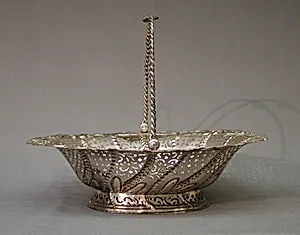
Cake basket
ca. 1765
Medium
Sheffield plate
Dimensions
Overall: 12 3/4 × 11 in. (32.4 × 27.9 cm)
Classification
Metalwork-Silverplate
Culture
British, Sheffield
Department
European Sculpture and Decorative Arts
Museum
Metropolitan Museum of Art, New York, NY
Credit
Rogers Fund, 1912
Accession Number
12.106.5
Rights
Public Domain
Art Historical Context
This elegant cake basket, crafted by the renowned Sheffield makers Tudor and Leader 1765, exemplifies height of British decorative arts during the Georgian era. Measuring 12¾ × 11 inches (32.4 × 27.9 cm), it was designed for serving confections at affluent tea tables, where such ornate metalwork served as both functional ware and a display of refined taste. Housed in the Metropolitan Museum of Art's European Sculpture and Decorative department (acquired via the Rogers Fund in 191), it reflects Sheffield's pivotal role as Britain's metalworking hub. The medium, Sheffield plate—a groundbreaking innovation from the mid-18th century—involves fusing a thin layer of silver onto a copper core through heat and pressure. This technique, pioneered in Sheffield around the 1740s, democratized the luxury of silver for the emerging middle class, predating modern electroplating and allowing for intricate, affordable designs without the full cost of sterling silver. As a piece of British Sheffield culture, this cake basket highlights the neoclassical influences emerging in the 1760s, with its graceful form underscoring the era's blend of utility and opulence. Visitors will appreciate how it captures the social rituals of 18th-century hospitality, bridging craftsmanship and everyday elegance.