
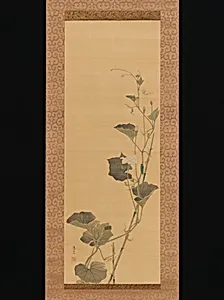
Calabash Flowers and Beetle
early 19th century
Medium
Hanging scroll; ink and color on silk
Dimensions
Image: 39 1/4 × 14 5/16 in. (99.7 × 36.3 cm) Overall with mounting: 77 3/8 × 19 13/16 in. (196.5 × 50.4 cm) Overall with knobs: 77 3/8 × 22 3/16 in. (196.5 × 56.3 cm)
Classification
Paintings
Culture & Period
Japan · Edo period (1615–1868)
Department
Asian Art
Museum
Metropolitan Museum of Art, New York, NY
Credit
Mary Griggs Burke Collection, Gift of the Mary and Jackson Burke Foundation, 2015
Accession Number
2015.300.200
Rights
Public Domain
Tags
Art Historical Context
Maruyama Ōshin's *Calabash Flowers and*, an exquisite hanging scroll from the early 19th century, captures the delicate beauty of nature during Japan's Edo period (16151868). Painted in ink and color on silk, this work exemplifies the Maruyama-Shijō school's realistic style, pioneered by Ōshin's teacher, Maruyama Ōkyo. The school blended Western-inspired perspective with traditional Japanese techniques, emphasizing lifelike depictions of flora and fauna to evoke the transient wonders of the natural world. The composition highlights blooming calabash flowers—vibrant gourds symbolizing abundance and summer—and a meticulously rendered beetle, showcasing Ōshin's mastery of fine brushwork. Subtle gradations of color and ink washes bring texture and depth to the silk surface, making the insects and petals seem almost tangible. Hanging scrolls like this were cherished in elite homes for display during seasonal gatherings, serving as meditative focal points. This piece, now in the Metropolitan Museum of Art's Mary Griggs Burke Collection, reflects Edo Japan's cultural reverence for nature's harmony, where even humble insects held poetic significance. Visitors will appreciate its intimate scale (39¼ × 14½ in.) and the way it invites quiet contemplation of life's fleeting details.