
Calendar watch
ca. 1650
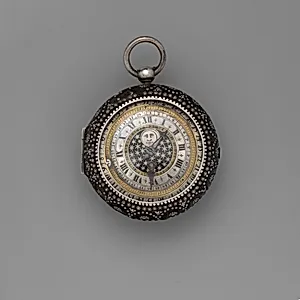
Medium
Outer case: leather-covered silver with silver piqué work; Inner case: silver; Movement: gilt brass, steel, partly blued, and silver
Dimensions
Diam. 1-3/4 in. (4.4 cm)
Classification
Horology
Culture
British, London
Department
European Sculpture and Decorative Arts
Museum
Metropolitan Museum of Art, New York, NY
Credit
Gift of J. Pierpont Morgan, 1917
Accession Number
17.190.1470
Rights
Public Domain
Tags
Art Historical Context
Step into the intricate world of 17th British horology with Thomas Alcock's *Calendar Watch*, crafted around 1650 in London. petite timepiece, just 1-3/4 inches (4.4 cm) in, exemplifies the era's blend of scientific precision and artistic elegance. Alcock, a skilled London watchmaker, created a functional marvel that not only told time but also tracked the calendar— a sophisticated feature for an age when accurate timekeeping was revolutionizing navigation, science, and daily life amid England's turbulent Civil War period. The watch's dual cases showcase exquisite craftsmanship: the outer one in leather-covered silver adorned with silver *piqué* work, a delicate technique of inlaid silver wires forming intricate patterns, evoking the opulence of courtly accessories. Inside, a silver case protects the movement of gilt brass, steel (partly blued for a striking iridescent hue), and silver components, highlighting the metallurgical artistry of the time. Such watches were status symbols for the elite, merging utility with decorative flair. Generously gifted to the Metropolitan Museum of Art by J. Pierpont Morgan in 1917, this treasure from the European Sculpture and Decorative Arts department invites us to marvel at how a tiny object captured the cosmos of time, bridging Renaissance ingenuity and the dawn of the Enlightenment.