
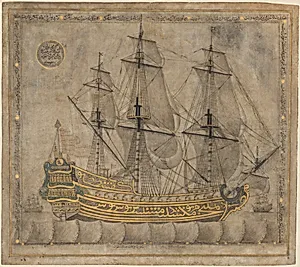
Calligraphic Galleon
dated A.H. 1180/ 1766–67 CE
Medium
Ink and gold on paper
Dimensions
H. 19 in. (48.3 cm) W. 17 in. (43.2 cm)
Classification
Codices
Department
Islamic Art
Museum
Metropolitan Museum of Art, New York, NY
Credit
Louis E. and Theresa S. Seley Purchase Fund for Islamic Art and Rogers Fund, 2003
Accession Number
2003.241
Rights
Public Domain
Tags
Art Historical Context
Created in 1766–67 by the Ottoman calligrapher ‘Abd al-Qadir Hisari, *Calligraphic Galleon* transforms sacred script into a striking visual image. Rendered in ink and gold on paper, the composition forms a majestic three-masted ship whose sails, hull, and rigging are entirely composed of elegantly flowing Arabic letters. This rare fusion of text and image reflects a sophisticated Ottoman artistic practice in which calligraphy—considered the highest art form—could also serve as pictorial expression. The use of gold highlights the spiritual and aesthetic value placed on the written word, while the ship motif may evoke themes of journey, trade, or divine protection common in Islamic visual culture. Measuring just under two feet square, the work demonstrates remarkable technical control, as every curve and line must simultaneously convey both legible text and convincing nautical form. Acquired by the Metropolitan Museum in 2003, this piece offers visitors a vivid example of how 18th-century Ottoman artists pushed the boundaries of traditional calligraphy, turning words into a floating world of beauty and meaning.