
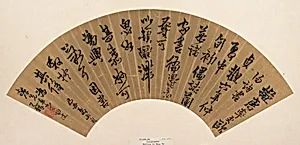
明/清 佚名 倣王鐸 行草書 扇|Calligraphy
17th century or later, spurious date of 1649
Medium
Folding fan mounted as an album leaf; ink on paper
Dimensions
6 3/8 x 20 1/4 in. (16.2 x 51.4 cm)
Classification
Calligraphy
Culture & Period
China · Qing dynasty (1644–1911)
Department
Asian Art
Museum
Metropolitan Museum of Art, New York, NY
Credit
John Stewart Kennedy Fund, 1913
Accession Number
13.100.54
Rights
Public Domain
Tags
Art Historical Context
This folding fan, now preserved as an album leaf, a work of Chinese calligraphy in running-cursive script, brushed in ink on paper. Dating to the 17th century later in the Qing dynasty, it carries a later-added date of 1649 and was created by an unidentified artist in imitation of Duo, a leading calligrapher of the late Ming era. Wang Duo’s energetic, flowing style—merging running and cursive scripts—became a model for later generations, who copied his work both as practice and as tribute. The imitation here reflects a long-standing Chinese tradition in which studying and emulating masters was essential to an artist’s training and a way to keep earlier achievements alive. Calligraphy itself ranks among China’s highest arts, valued for the way brush rhythm and ink variation reveal the writer’s inner character. Folding fans were intimate, portable objects often inscribed with poetry or reflections; mounting them as album leaves allowed collectors to enjoy and protect them. This piece invites viewers to appreciate both the technical grace of the script and the cultural practice of homage that shaped Chinese artistic life.
About the Artist
Wang Duo|Unidentified artist (Chinese) · 1592 –1652
Chinese, 1592–1652