
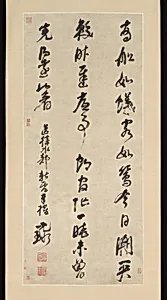
明 倪元璐 行草書七絕詩 軸|Calligraphy
Medium
Hanging scroll; ink on paper
Dimensions
Image: 54 7/8 x 24 1/4 in. (139.4 x 61.6 cm) Overall with mounting: 111 x 31 1/2 in. (281.9 x 80 cm) Overall with knobs: 111 x 34 1/2 in. (281.9 x 87.6 cm)
Classification
Calligraphy
Culture & Period
China · Ming dynasty (1368–1644)
Department
Asian Art
Museum
Metropolitan Museum of Art, New York, NY
Credit
Bequest of John M. Crawford Jr., 1988
Accession Number
1989.363.122
Rights
Public Domain
Art Historical Context
Ni Yuanlu's *Running Cursive Script: Seven-Character Quatrain Poem* is a masterful example of Ming dynasty (1368–1644) calligraphy, rendered as an elegant hanging scroll in ink on paper. This vertical format, measuring over 9 feet tall when fully mounted, was designed for dramatic display in a scholar's studio or hall, allowing viewers to unroll and savor its rhythms up close. Ni Yuanlu, a prominentati figure, captures a short jueju poem—China's classical four-line verse form—in fluid xingcao (running cursive) script, blending the structured poise of running script with the free-spirited energy of cursive. The artwork's artistic significance lies in its dynamic brushwork, where strokes vary from bold, sweeping arcs to delicate pauses, embodying the emotional expressiveness prized in Ming calligraphy. Ink on paper, a timeless medium, highlights the artist's control over fluidity and density, turning poetry into visual music. As both poem and script, it reflects the intertwined ideals of wenren (literati) culture, where mastery of the brush signified moral and intellectual refinement. Housed in the Metropolitan Museum of Art's Asian Art Department, this scroll, bequeathed by John M. Crawford Jr. in 1988, offers a window into late imperial China's aesthetic world, where calligraphy reigned as the pinnacle of artistic achievement.
About the Artist
Ni Yuanlu · 1593–1644
Chinese, 1593–1644