
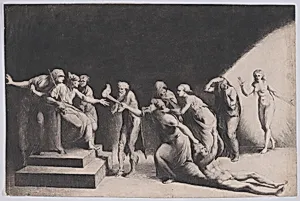
Calumny after Raphael
Medium
Aquatint and engraving; third state of three
Dimensions
Sheet: 11 13/16 × 17 15/16 in. (30 × 45.6 cm)
Classification
Prints
Department
Drawings and Prints
Museum
Metropolitan Museum of Art, New York, NY
Credit
The Elisha Whittelsey Collection, The Elisha Whittelsey Fund, 1967
Accession Number
67.540.2
Rights
Public Domain
Art Historical Context
This aquatint and engraving titled *Calumny after Raphael* captures the refined elegance of the High Renaissance master Raffaello Sanzio through the skilled hand of Baron Dominique Vivant Denon. Created as a reproductive print, it translates Raphael’s harmonious figures and balanced composition into a medium that allowed broader audiences to appreciate his designs beyond the original painting or drawing. Denon, a prominent French artist, collector, and later director of the Louvre, played a key role in documenting and disseminating Italian Renaissance works during the late 18th and early 19th centuries. The choice of aquatint combined with engraving was particularly effective for conveying subtle tonal gradations and fine linear details, techniques that helped replicate the luminous quality of Raphael’s originals. As the third state of three, this impression reflects the artist’s careful refinements to achieve greater clarity and depth. Such prints served not only as artistic records but also as cultural ambassadors, bringing the ideals of Renaissance beauty and narrative drama to collectors and scholars across Europe. Housed in the Metropolitan Museum of Art’s Department of Drawings and Prints as part of the Elisha Whittelsey Collection, the work highlights the enduring influence of Raphael’s compositions and the vital role reproductive prints played in shaping art history.