
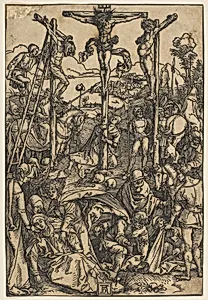
Calvary with the Three Crosses
ca. 1503
Medium
Woodcut
Dimensions
sheet: 8 3/8 x 5 3/4 in. (21.3 x 14.6 cm)
Classification
Prints
Department
Drawings and Prints
Museum
Metropolitan Museum of Art, New York, NY
Credit
The Elisha Whittelsey Collection, The Elisha Whittelsey Fund, 1951
Accession Number
51.573
Rights
Public Domain
Tags
Art Historical Context
In the quiet intensity of Albrecht Dürer's *Calvary with the Threees* (ca. 1503), visitors encounter a poignant woodcut capturing the Crucifixion—one of Christianity's most sacred moments. The composition centers on the three crosses atop Calvary: Christ's at the fore, flanked by the thieves', evoking profound sorrow and redemption. At just 8 3/8 x 5 3/4 inches, this intimate print invites close contemplation, its stark black-and-white drama drawing the eye to the figures' expressive anguish. Dürer, a master of the Northern Renaissance, revolutionized woodcuts with unprecedented detail and precision, rivaling the finesse of engravings. Working in Nuremberg around 1503, he bridged Gothic traditions with emerging Renaissance humanism, influenced by his Italian travels. This technique allowed mass production of devotional images, making profound religious art accessible to laity amid the late medieval piety that preceded the Reformation. Housed in the Metropolitan Museum of Art's Drawings and Prints department, this piece from The Elisha Whittelsey Collection exemplifies Dürer's enduring legacy in printmaking. It not only reflects the era's spiritual fervor but also showcases his innovative line work, where bold contours and subtle textures convey emotional depth, reminding us of art's power to make the divine feel profoundly human.
About the Artist
Albrecht Dürer · 1471–1528
Albrecht Dürer (1471–1528) stands as the preeminent figure of the Northern Renaissance and arguably the most influential artist in the history of printmaking. Born in Nuremberg on May 21, 1471, and dying in the same city on April 6, 1528, Dürer revolutionized the status of the artist in Northern Europe, transforming printmaking from a commercial craft into an independent fine art and establishing ...