
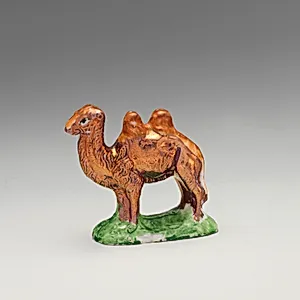
Camel
19th century
Medium
Lustreware
Dimensions
Height: 2 5/8 in. (6.7 cm)
Classification
Ceramics-Pottery
Culture
British
Department
European Sculpture and Decorative Arts
Museum
Metropolitan Museum of Art, New York, NY
Credit
Gift of Sidney H. and Helen M. Witty, 1964
Accession Number
64.173.98
Rights
Public Domain
Tags
Art Historical Context
Nestled in the Metropolitan Museum of Art's European Sculpture and Decorative Arts, *Camel* is a delicate 19th-century lustreware figurine crafted by British potter Mary Atwood. Standing just 2 5/8 inches (6.7 cm) tall, this ceramic pottery piece captures the graceful form of a camel in miniature, gifted to the museum in 1964 by Sidney H and Helen M. Wit. Its petite scale suggests it was designed as a charming table ornament or collector's item, embodying the Victorian fascination with exotic animals and intricate craftsmanship. Lustreware, Atwood's chosen medium, revives an ancient technique originating from the Islamic world and popularized in 19th-century Britain. By applying metallic oxides to the glazed surface and firing it in a reduced-oxygen kiln, potters achieved a shimmering, iridescent sheen that mimics precious metals—an affordable luxury for the growing middle class. This method highlights Atwood's skill in the British ceramics tradition, where studios like those in Staffordshire experimented with luster effects to elevate everyday pottery into art. Culturally, the camel evokes the British Empire's global reach, symbolizing trade routes and orientalist curiosities. As a testament to women's contributions to decorative arts, Atwood's work adds a personal touch to this era's industrial pottery boom, inviting visitors to appreciate the blend of whimsy, technique, and history in a single, sparkling form.