
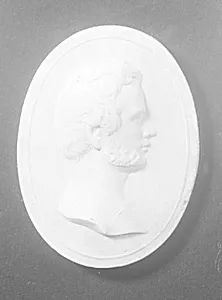
Cameo of a Gentleman
ca. 1850
Medium
Plaster
Dimensions
2 x 1 1/2 in. (5.1 x 3.8 cm)
Classification
Cameo
Culture
American
Department
The American Wing
Museum
Metropolitan Museum of Art, New York, NY
Credit
Gift of Dr. Clark S. Marlor, 1983
Accession Number
1983.519.7
Rights
Public Domain
Tags
Art Historical Context
Nestled in the American Wing of the Metropolitan Museum of Art, *Cameo of a Gentleman* by Erastus Dow Palmer, created around 1850, captures the refined elegance of mid-19th-century portrait. This petite plaster relief, measuring just 2 x 1 1/2 inches, depicts a male profile in the classic cameo tradition—a high-relief carving evoking ancient Roman gems. Palmer, a pioneering American sculptor from upstate New York, elevated cameos from mere jewelry to fine art, often crafting them as affordable yet intricate likenesses for a burgeoning middle class. Plaster, unlike the more precious shell or sardonyx Palmer famously used, served as an ideal medium for studies and prototypes, allowing precise modeling of facial features, hair, and attire. This technique highlighted his neoclassical precision, influenced by the era's revival of Greco-Roman aesthetics amid America's cultural awakening. The anonymous gentleman's dignified pose reflects Victorian ideals of masculinity and restraint. A gift to the Met in 1983, this cameo offers a window into everyday artistry, blending personal portraiture with classical grandeur. Visitors will appreciate its tactile intimacy, a testament to Palmer's mastery in miniaturizing monumentality.