
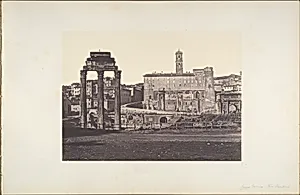
Campo Vaccino (Foro Romano)
1848–52
Medium
Albumen print from glass negative
Dimensions
Image: 8 1/16 × 11 3/16 in. (20.5 × 28.4 cm) Sheet: 12 1/8 × 18 1/2 in. (30.8 × 47 cm)
Classification
Photographs
Department
Photographs
Museum
Metropolitan Museum of Art, New York, NY
Credit
Gilman Collection, Museum Purchase, 2005
Accession Number
2005.100.799 (19)
Rights
Public Domain
Tags
Art Historical Context
Step into the sunlit ruins of ancient Rome with *Campo Vaccino (Foro)*, a captivating albumen print by French photographer Eugène Constant, between 1848 and1852. The title refers to the Roman Forum's medieval nickname—"cow field"—as it had become a grazing pasture amid overgrown classical remnants. Constant's lens captures the majestic columns and arches of temples and basilicas, evoking the grandeur of imperial Rome while highlighting its picturesque decay during the mid-19th century. This photograph, measuring about 8 x 11 inches, exemplifies early photography's power to document archaeology. Printed from a glass negative using the albumen process—introduced in 1847 by Louis Désiré Blanquard-Évrard—it achieves remarkable tonal depth and fine detail, making distant architectural fragments strikingly vivid. Constant, active in Rome's vibrant expatriate artist community, contributed to a wave of calotypes and salted paper prints that preserved sites amid ongoing excavations. Housed in The Metropolitan Museum of Art's Gilman Collection, this work underscores photography's role in bridging antiquity and modernity, offering 19th-century viewers (and us today) an intimate glimpse of history frozen in time. A testament to the medium's archival precision, it invites reflection on Rome's enduring legacy.
About the Artist
Eugène Constant · 1848–1855
Eugène Constant (before 1820 – after 1860) was a French painter who became one of the pioneering photographers of the 19th century, capturing the grandeur of Italy's ancient monuments with unprecedented clarity.) Trained as a painter in Paris during the early 1840s, where he maintained a studio at 31 rue du Marché-Saint-Honoré, Constant exhibited interior views of Venice's Basilica of San Marco an...