
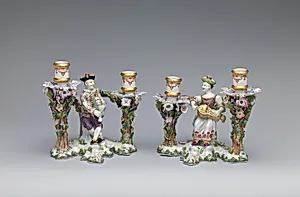
Candelabrum (one of a pair)
Medium
Hard-paste porcelain
Dimensions
6 13/16 × 6 7/8 in. (17.3 × 17.5 cm)
Classification
Ceramics-Porcelain
Culture
Austrian, Vienna
Department
European Sculpture and Decorative Arts
Museum
Metropolitan Museum of Art, New York, NY
Credit
Gift of Irwin Untermyer, 1964
Accession Number
64.101.234
Rights
Public Domain
Tags
Art Historical Context
This elegant candelabrum, crafted around 1740 in Vienna during the Du Paquier period, exemplifies the early achievements of European porcelain manufacturing. Produced at the Vienna factory founded by Claudius Innocentius Du Paquier, it represents one of the first successful attempts outside China to create hard-paste porcelain—a durable, translucent material that required precise high-temperature firing techniques. Standing just under seven inches tall, this piece, one of a matching pair, would have served both practical and ornamental purposes in an aristocratic interior, holding candles while showcasing intricate figural decoration. The Du Paquier factory operated from 1718 to 174 and became renowned for its inventive forms and lively painted scenes before the manufactory came under state control. Decorated with musicians, men, women, and floral motifs, the candelabrum reflects the playful Rococo taste of the era, where music and courtly figures often adorned luxury objects. Such works highlight how Viennese porcelain bridged functionality and fine art, elevating everyday items into status symbols for 18th-century European elites. Today, this Austrian porcelain piece resides in the Metropolitan Museum of Art’s collection of European Sculpture and Decorative Arts, gifted by Irwin Untermyer in 1964. It offers visitors a glimpse into the technical innovation and cultural refinement that defined Vienna’s porcelain tradition during its formative years.