
Candlestick
Unknown Artist
1670–1700
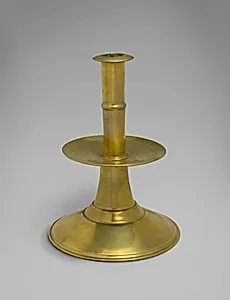
Medium
Brass
Dimensions
H. 8 1/2 in. (21.6 cm); Diam. 6 1/8 in. (15.6 cm)
Classification
Candlestick
Department
The American Wing
Museum
Metropolitan Museum of Art, New York, NY
Credit
Bequest of Flora E. Whiting, 1971
Accession Number
1971.180.69
Rights
Public Domain
Art Historical Context
This elegant brass candlestick, crafted between 1670 and 1700 by an unknown artisan, exemplifies the sturdy yet refined metalwork of colonial America. Standing at 8½ inches tall with a 6⅛-inch diameter base, its simple, baluster-shaped form—likely turned on a lathe—was designed for practical use in dimly lit households, holding a beeswax or tallow candle to illuminate homes before widespread electricity. Housed in The Metropolitan Museum of Art's American Wing, this piece reflects the craftsmanship of early American metalsmiths, who often worked with imported brass due to limited local smelting. Brass, prized for its durability, golden hue, and resistance to corrosion, symbolized modest prosperity in the New England or Mid-Atlantic colonies during a time of Puritan restraint and emerging trade networks. Such candlesticks were essential for evening prayers, meals, and work, blending European turning techniques with colonial ingenuity. Bequeathed by Flora E. Whiting in 1971, it offers a tangible glimpse into 17th-century daily life, highlighting how humble objects carried artistic merit through precise proportions and functional beauty. Visitors can appreciate how these survivors of history preserve the quiet elegance of America's founding era.