
Candlestick
1760–70
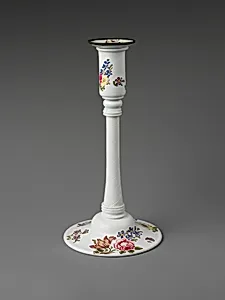
Medium
Opaque glass with enamel decoration
Dimensions
9 5/16 × 4 11/16 × 4 11/16 in. (23.7 × 11.9 × 11.9 cm)
Classification
Candlestick
Culture
British
Department
The American Wing
Museum
Metropolitan Museum of Art, New York, NY
Credit
Bequest of Mrs. J. Insley Blair, 1951
Accession Number
52.77.39a, b
Rights
Public Domain
Tags
Art Historical Context
This elegant candlestick, crafted by British glassmaker Michael Edkins 1760 and 1770, exemplifies the refined artistry of mid-18th-century opaque glass production. Standing at just over 9 inches tall with a square base measuring nearly 4¾ inches across, it was designed for tabletop illumination, blending functionality with decorative appeal. The opaque glass—often likened to milky porcelain—provided a smooth, luminous canvas, while vibrant enamel decorations, likely featuring floral motifs as suggested by its tags, added colorful, durable embellishments fired directly onto the surface. Edkins, hailing from Birmingham's thriving glassmaking tradition, contributed to a period when British artisans innovated with affordable yet luxurious materials, rivaling expensive ceramics. Enamel techniques allowed for intricate, long-lasting patterns that captured the era's Rococo taste for naturalistic flowers and organic forms. Though British in origin, its placement in The American Wing of The Metropolitan Museum of Art speaks to the transatlantic exchange of luxury goods, possibly gracing colonial homes. Bequeathed by Mrs. J. Insley Blair in 1951, this piece invites visitors to appreciate how everyday objects became canvases for artistic expression, bridging utility and beauty in Georgian Britain.