
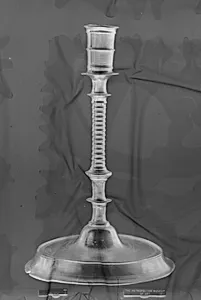
Candlestick
Unknown Artist
16th century
Medium
Brass
Dimensions
Height: 9 1/8 in. (23.2 cm)
Classification
Metalwork-Brass
Culture
German
Department
European Sculpture and Decorative Arts
Museum
Metropolitan Museum of Art, New York, NY
Credit
Gift of W. L. Hildburgh, 1932
Accession Number
32.64.42
Rights
Public Domain
Art Historical Context
This elegant 16th-century German candlestick, standing at just over 9 inches tall, exemplifies the refined metalwork of Renaissance Europe. Crafted by unknown artisan, it belongs to the Metropolitan Museum of Art's European Sculpture and Decorative Arts, generously gifted by W. L. Hildburgh in 2. Brass, an alloy of copper and zinc, was for its malleability and golden sheen, allowing skilled smiths to cast, hammer, and chase intricate designs that blended utility with subtle ornamentation. In 16th-century Germany, amid the flourishing Northern Renaissance, such candlesticks illuminated homes, workshops, and churches, symbolizing both everyday practicality and emerging artistic sophistication. German metalworkers drew on local traditions of Gothic tracery while embracing Renaissance humanism, often incorporating motifs like foliage or figures to elevate functional objects into heirlooms. This piece reflects that craftsmanship, highlighting the era's technical prowess in producing durable, corrosion-resistant wares. Though modest in scale, it offers a window into pre-industrial artistry, where hand-forged brass bridged the medieval and modern worlds. Visitors can appreciate how such items fostered cultural continuity, from feudal halls to bourgeois interiors.