
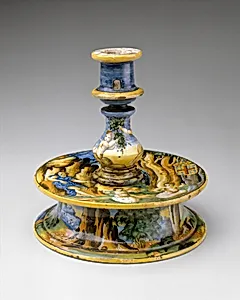
Candlestick (candeliere)
Medium
Maiolica (tin-glazed earthenware)
Dimensions
Height: 8 1/16 in. (20.5 cm)
Classification
Ceramics-Pottery
Culture
Italian, Urbino
Department
Robert Lehman Collection
Museum
Metropolitan Museum of Art, New York, NY
Credit
Robert Lehman Collection, 1975
Accession Number
1975.1.1121
Rights
Public Domain
Tags
Art Historical Context
This elegant candlestick, or *candeliere*, hails from the workshop of Guido Durantino in Urbino, Italy, dated 1535. Crafted during the Renaissance, when Urbino was a hub for maiolica production, it exemplifies the city's mastery of tin-glazed earthenware Standing just over 8 inches tall, this piece from the Robert Lehman Collection at The Metropolitan Museum of Art was designed for both practical illumination and decorative display in affluent homes. Maiolica's brilliance comes from its tin glaze, which created a smooth, white surface ideal for vibrant painted scenes fired at low temperatures. Durantino's workshop specialized in *istoriato* style—narrative vignettes drawn from classical mythology—often featuring graceful female figures. Here, the candlestick likely depicts Leda, the mythical beauty from Greek lore seduced by Zeus in swan form, a popular Renaissance motif symbolizing divine love and transformation. Such imagery blended pagan tales with Christian-era artistry, showcasing the era's humanist revival. As a functional yet luxurious object, this candlestick highlights how ceramics rivaled painting and sculpture in 16th-century Italy, exported across Europe as status symbols. Its survival offers a glimpse into Renaissance domestic life and the technical ingenuity of Urbino potters.