
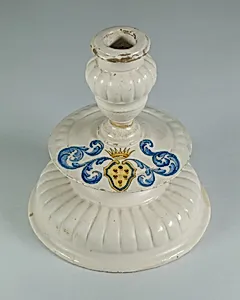
Candlestick (candeliere)
Unknown Artist
mid-17th century
Medium
Maiolica (tin-glazed earthenware)
Dimensions
Height: 7 3/8 in. (18.7 cm)
Classification
Ceramics-Pottery
Culture
Italian, possibly Montelupo
Department
Robert Lehman Collection
Museum
Metropolitan Museum of Art, New York, NY
Credit
Robert Lehman Collection, 1975
Accession Number
1975.1.1112
Rights
Public Domain
Tags
Art Historical Context
This elegant candlestick, known as a *candeliere*, hails from mid-17th-century Italy likely produced in the renowned maiolica workshops of Montelupo, Tuscany. Crafted from tin-glazed earthenware, stands just 7 3/8 inches tall, blending everyday utility with luxurious decoration. Maiolica, prized for its brilliant, glossy colors achieved through a tin-opacified glaze fired over earthenware, was a hallmark of Italian ceramics during the Baroque era, transforming humble clay into-like objects for affluent homes. A striking coat of arms adorns its surface, suggesting it was commissioned for a noble family or prominent household, symbolizing lineage and status. Montelupo's potters excelled in such personalized pieces, exporting them across Europe and influencing ceramic traditions far beyond Italy. The vivid enamels and intricate motifs reflect the period's opulent tastes, where functional items like candlesticks doubled as status symbols during candlelit dinners and evening gatherings. Now part of the Robert Lehman Collection at The Metropolitan Museum of Art, this anonymous masterpiece offers a glimpse into the artistry of Italy's ceramic golden age, where craftsmanship met heraldry in everyday elegance.