
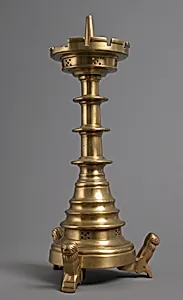
Candlestick, Pricket
Unknown Artist
15th century
Medium
Brass
Dimensions
Overall: 15 1/2 x 6 5/16 in. (39.4 x 16 cm)
Classification
Metalwork-Brass
Culture
South Netherlandish
Department
Medieval Art
Museum
Metropolitan Museum of Art, New York, NY
Credit
Bequest of George Blumenthal, 1941
Accession Number
41.190.122
Rights
Public Domain
Art Historical Context
This elegant pricket candlestick, crafted in the 15th century by an unknown South Netherlandish, exemplifies the refined metalwork of the late medieval Low Countries. Standing at 15 1/2 inches tall, its brass construction features a sturdy base and a central spike designed to securely hold a taper candle, making it ideal for both ecclesiastical and domestic use. Housed in the Metropolitan Museum of Art's Art department, it entered the collection through the bequest of George Blument in 1941. South Netherlandish brasswork flourished during this era, a time of economic prosperity fueled by trade and urban guilds in cities like Brussels and Antwerp. Artisans employed sophisticated techniques such as casting, hammering, and possibly chasing or engraving to create durable, luminous objects that illuminated altars, refectories, and noble halls. The pricket's simple yet balanced form reflects Gothic influences, prioritizing functionality with subtle ornamental potential. As a survivor from the turbulent late Middle Ages, this candlestick offers a glimpse into everyday medieval life, where light symbolized divine presence and practical necessity. Its patina today whispers of centuries of flickering flames and devoted hands.