
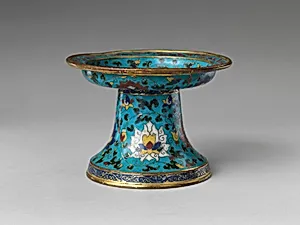
明早期 掐絲琺瑯纏枝蓮紋燭臺|Candlestick with lotus scrolls
Unknown Artist
late 14th–early 15th century
Medium
Cloisonné enamel
Dimensions
H. 4 1/4 in. (10.8 cm); Diam.of rim 5 3/4 in. (14.6 cm); Diam. of base 4 1/2 in. (11.4 cm)
Classification
Cloisonné
Culture & Period
China · Ming dynasty (1368–1644)
Department
Asian Art
Museum
Metropolitan Museum of Art, New York, NY
Credit
Gift of Edward G. Kennedy, 1929
Accession Number
29.110.37
Rights
Public Domain
Art Historical Context
This delicate cloisonné enamel candlestick, crafted in early Ming dynasty China (late 14th–early 15th century exemplifies the era's burgeoning mastery of luxury metalwork. Adorned with intricate twining lotus scrolls—graceful branches of blooming lotuses that wrap around its surface—the piece stands just over 4 inches tall, with a flared rim and sturdy base ideal for holding a candle. The vibrant enamels, likely in shades of blue, turquoise, and white, create a luminous effect against the metal framework, transforming a functional object into a work of art. Cloisonné enamel, a technique where thin wires of metal form compartments (cloisons) filled with powdered glass enamel, fired layer by layer, was introduced to China from the Middle East via the Mongol Yuan dynasty (1279–1368). By the Ming period, it flourished as a courtly craft, producing opulent wares for imperial use or elite homes. This rare early example highlights the transition from experimentation to refinement, showcasing the artisans' skill in achieving durable, jewel-like colors. In Chinese culture, the lotus symbolizes purity and enlightenment, rising unsullied from muddy waters—a Buddhist motif resonating in Ming aesthetics. Donated to The Metropolitan Museum of Art in 1929 by Edward G. Kennedy, this candlestick offers a glimpse into the sophisticated tastes of China's founding dynasty, blending utility, spirituality, and technical innovation.