
Candlesticks
Unknown Artist
868–905
Medium
Glass; free blown
Dimensions
H. ca. 5 1/4 in. (13.4 cm) Diam. of base: 3 7/8 in. (9.8 cm) H. ca. 5 1/8 in. (13.0 cm) Diam. of base: 3 5/8 in. (9.2 cm)
Classification
Glass
Department
Islamic Art
Museum
Metropolitan Museum of Art, New York, NY
Credit
Gift of Charles K. and Irma B. Wilkinson, 1977
Accession Number
1977.392.3
Rights
Public Domain
Art Historical Context
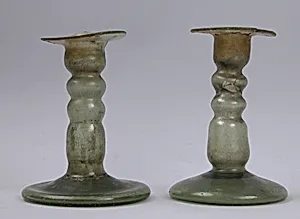
These delicate glass candlesticks, by an unknown artist between 868 and 905 CE, hail from the Islamic world during the Abbasid Caliph—a golden age of innovation and artistry. Standing about 5 inches tall with sturdy bases around 3.5–4 inches in diameter, exemplify free-blown glass technique, where molten glass is gathered on a blowpipe and inflated into shape. This method, refined by Islamic artisans in regions like Syria, Iraq, and Egypt, allowed for elegant, symmetrical forms that were both functional and decorative, transforming everyday lighting into objects of beauty. In the 9th–10th centuries, Islamic glassmaking reached extraordinary heights, producing wares that were traded across continents from Europe to China. These candlesticks reflect that mastery: their slender profiles and precise proportions highlight the skill in controlling viscosity and cooling to avoid imperfections. Often used in homes, mosques, or palaces, such pieces illuminated lives while symbolizing prosperity and refined taste. Now treasured in the Metropolitan Museum of Art's Islamic Art department (gift of Charles K. and Irma B. Wilkinson, 1977), they invite us to appreciate how ancient craftsmen turned sand and fire into enduring elegance, bridging utility and art across a millennium.