
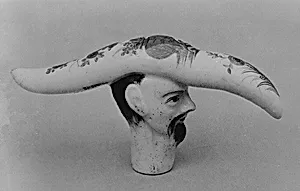
Cane handle
possibly ca. 1740
Medium
Soft-paste porcelain
Dimensions
2 1/2 × 5 1/4 in. (6.4 × 13.3 cm)
Classification
Ceramics-Porcelain
Culture
French, possibly Saint-Cloud
Department
European Sculpture and Decorative Arts
Museum
Metropolitan Museum of Art, New York, NY
Credit
Gift of Mrs. Morris Hawkes, 1924
Accession Number
24.214.12
Rights
Public Domain
Tags
Art Historical Context
This delicate cane handle, crafted by the renowned Saint-Cloud porcelain factory around 1740, exemplifies elegance of early 18th-century French arts. Made from soft-paste porcelain pioneering European substitute for rare Chinese hard-paste porcelain—this small sculpture (just 2½ × 5¼ inches) likely features a finely modeled male figure, reflecting the factory's expertise in miniature figural work. Saint-Cloud, active near Paris from the late 17th century, was among the first to produce this translucent, creamy material, fired at lower temperatures to achieve a soft glow prized by the aristocracy. Soft-paste porcelain represented a technological triumph during the Rococo era, when luxury objects like walking-stick handles symbolized refined taste and social status. These handles, often attached to elegant canes carried by gentlemen, blended functionality with artistry, showcasing intricate molding, gilding, or painted details that captured human forms with lifelike charm. The Saint-Cloud factory's innovations helped fuel France's porcelain mania, paving the way for later masters like Sèvres. Today, this gift to the Metropolitan Museum of Art offers a glimpse into the opulent world of Versailles-era elites, where everyday accessories became canvases for sculptural finesse. A testament to French ingenuity, it invites us to appreciate the fragile beauty of porcelain's early European chapter.
About the Artist
Saint-Cloud factory · 1693–1766
The Saint-Cloud porcelain factory, situated on the Seine in the town of Saint-Cloud near Paris, revolutionized European ceramics as the first to manufacture soft-paste porcelain commercially, beginning in 1693. Originally established around 1664-1666 as a faience workshop, it shifted to porcelain under Pierre Chicaneau, a potter whose experiments yielded a frit-based paste with a warm yellowish or...