
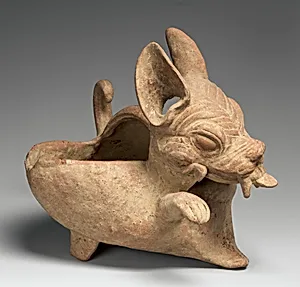
Canine Vessel
8th–9th century
Medium
Ceramic
Dimensions
H 6 3/4 × W. 5 3/4 × D. 7 7/16 in. (17.1 × 14.6 × 18.9 cm)
Classification
Ceramics-Containers
Culture
Remojadas (?)
Department
Arts of Africa, Oceania, and the Americas
Museum
Metropolitan Museum of Art, New York, NY
Credit
The Michael C. Rockefeller Memorial Collection, Bequest of Nelson A. Rockefeller, 1979
Accession Number
1979.206.1099
Rights
Public Domain
Tags
Art Historical Context
This charming *Canine Vessel*, crafted by artists from south-central Veracruz in the 8th–9th century, exemplifies the vibrant ceramic traditions of pre-Columbian Mesoamerica. Possibly linked to the Remojadas culture—renowned for its lively, expressive pottery—this small container (measuring just 6 3/4 × 5 3/4 × 7 7/16 inches) takes the form of a dog, highlighting the region's fascination with animal motifs. Dogs held significant roles in ancient Mesoamerican societies, often symbolizing companionship, hunting, or spiritual guides, making such vessels both utilitarian and ritually evocative. Fashioned from ceramic, the piece reflects sophisticated modeling techniques typical of Veracruz artisans, who hand-built forms with remarkable detail and fired them to achieve durability. As a classified "Ceramics-Container," it likely served everyday or ceremonial purposes, blending functionality with artistry. Its inclusion in The Michael C. Rockefeller Memorial Collection at The Metropolitan Museum of Art underscores its importance in preserving the artistic legacy of the Americas. Today, this vessel invites us to ponder the daily lives and beliefs of its creators, offering a tangible link to a thriving ancient culture where animals bridged the human and supernatural worlds.