
Cann
ca. 1825
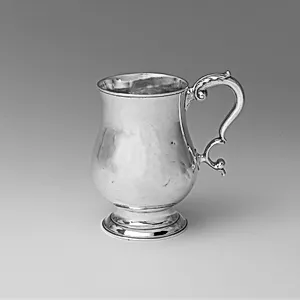
Medium
Silver
Dimensions
Overall: 5 3/4 x 5 5/8 in. (14.6 x 14.3 cm); 11 oz. 11 dwt. (358.5 g) Lip: Diam. 3 5/16 in. (8.4 cm) Base: Diam. 3 1/4 in. (8.3 cm)
Classification
Cann
Culture
American
Department
The American Wing
Museum
Metropolitan Museum of Art, New York, NY
Credit
Bequest of Alphonso T. Clearwater, 1933
Accession Number
33.120.262
Rights
Public Domain
Art Historical Context
Crafted around 1825 by New York silversmith George, *Cann* is a finely silver vessel exemplifying the elegance of early American decorative arts. Standing just 5¾ inches tall with a weight of nearly 12 ounces, its compact cylindrical form—featuring a lip diameter of 3⅜ inches and a matching base—suggests it served as aware item, perhaps a sugar bowl, canister, or small tankard for household use. The precision of its proportions reflects the high standards of Federal-era silversmithing, where artisans like Baker blended British influences with emerging American craftsmanship. In the context of post-Revolutionary America, silver objects like this symbolized prosperity and refinement among the growing merchant class. Baker, active in New York during the 1820s, contributed to a vibrant silversmithing tradition that emphasized neoclassical motifs and functional beauty. Housed in The Metropolitan Museum of Art's American Wing and acquired through the 1933 bequest of Alphonso T. Clearwater, *Cann* highlights the cultural importance of such pieces in everyday life, bridging utility and artistry in the young republic's material culture. Today, it invites visitors to appreciate the tactile allure of hand-hammered silver—its subtle sheen and heft evoking the dinner tables of 19th-century America.