
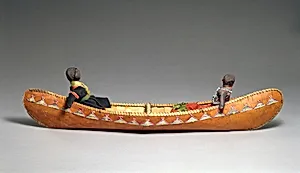
Canoe Model with Dolls
Unknown Artist
ca. 1860
Medium
Canoe: Birchbark, wood, quill Dolls: Silk, cotton, wool, glass, resin
Dimensions
Canoe: H. 4 3/4 x W. 4 3/4 x L. 22 in. (12.1 x 12.1 x 55.9 cm) Doll: 7 in. (17.8 cm) Doll: 7 1/2 in. (19.1 cm)
Classification
Bark-Sculpture
Culture
Micmac
Department
Arts of Africa, Oceania, and the Americas
Museum
Metropolitan Museum of Art, New York, NY
Credit
Ralph T. Coe Collection, Gift of Ralph T. Coe Foundation for the Arts, 2011
Accession Number
2011.154.7a–c
Rights
Public Domain
Tags
Art Historical Context
This enchanting *Canoe Model with Dolls*, crafted by an unknown Mi'kmaq artist around 1860, offers a glimpse into the maritime world of the Mi'kmaq people of Atlantic Canada and the northeastern United States. Measuring about 22 inches long, the delicate birchbark canoe—complete with wooden framing and porcupine quill decorations—holds two finely dressed dolls, each around 7-7.5 inches tall. These figures, adorned in silk, cotton, wool, glass beads, and resin, evoke paddlers or travelers, capturing the essential role of canoes in Mi'kmaq daily life, from fishing and hunting to trade along coastal waterways. Birchbark, a hallmark material in Indigenous Northeastern Woodlands art, was prized for its waterproof qualities and flexibility, allowing Mi'kmaq artisans to sew watertight vessels using spruce root. The quillwork adds vibrant, intricate patterns, a technique where dyed porcupine quills are wrapped and embroidered for both beauty and symbolism. The dolls' European trade fabrics reflect mid-19th-century cultural exchanges, blending Indigenous craftsmanship with imported goods during a period of increasing contact. As a rare bark sculpture in The Metropolitan Museum of Art's Arts of Africa, Oceania, and the Americas collection, this piece highlights Mi'kmaq ingenuity and storytelling through miniatures, possibly used as toys, teaching tools, or trade items. It invites us to paddle through history, appreciating the harmony of form, function, and cultural resilience.