
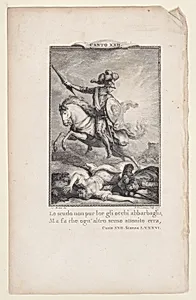
Canto 22, Stanza 86, from "Orlando Furioso"
Medium
Etching and engraving
Dimensions
Image: 5 3/8 × 3 9/16 in. (13.6 × 9.1 cm) Sheet: 9 3/16 × 5 13/16 in. (23.4 × 14.7 cm)
Classification
Prints
Department
Drawings and Prints
Museum
Metropolitan Museum of Art, New York, NY
Credit
The Elisha Whittelsey Collection, The Elisha Whittelsey Fund, 1959
Accession Number
59.500.583(21)
Rights
Public Domain
Art Historical Context
This etching and engraving illustrates a pivotal moment from Ludovico Ariosto’s celebrated Renaissance epic *Orlando Furioso* (1516–1532), specifically Canto 22, Stanza 86. Ariosto’s sprawling chivalric romance, filled with knights, enchanted forests, and star-crossed lovers, captivated European audiences for centuries. By the late 1700s, publishers frequently commissioned fresh illustrations to accompany new editions, transforming the poem’s vivid episodes into accessible visual companions for readers. Created in 1772, the print reflects the refined techniques of eighteenth-century book illustration. Etching allowed the artist to render fluid, expressive lines for dramatic action, while engraving added crisp detail and tonal depth—ideal for capturing the poem’s dynamic scenes within a compact format. Charles Monnet, a French painter known for literary subjects, likely supplied the design, which engravers Nicolas de Launay and possibly G. Baskerville then translated onto the plate with meticulous skill. Housed today in the Metropolitan Museum of Art’s Department of Drawings and Prints, this work exemplifies how visual art extended the life of literary classics. Its modest scale and refined execution made Ariosto’s imaginative world available to a widening public, bridging Renaissance poetry and Enlightenment-era appreciation for narrative art.
About the Artist
Charles Monnet|G. Baskerville|Nicolas de Launay|Ludovico Ariosto · 1732–1810
Comment on works: History; Portraits; Decorative