
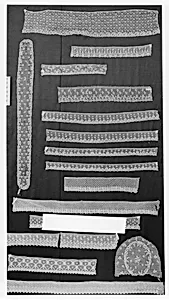
Cap crown
Unknown Artist
early 18th century
Medium
Needle lace, point d’Alençon
Dimensions
L. 10 1/2 x W. 8 1/2 inches (26.7 x 21.6 cm)
Classification
Textiles-Laces
Culture
French
Department
European Sculpture and Decorative Arts
Museum
Metropolitan Museum of Art, New York, NY
Credit
Rogers Fund, 1906
Accession Number
06.686
Rights
Public Domain
Art Historical Context
This delicate *Cap crown*, crafted in the early 18th century by an unknown French artisan, exemplifies the opulence of French decorative arts during the Regency period. Measuring just 10½ by 8½ inches, this small yet intricate piece was designed as the crowning element of a fashionable cap or headdress, often adorning the elite in Versailles courts or Parisian salons. Made from needle lace in the prestigious point d’Alençon technique, it the height of luxury textiles, where lace rivaled jewels as a status symbol. Point d’Alençon, originating from the Normandy town of Alençon, is renowned for its fine needlework—stitched entirely by hand with a single thread on a parchment pattern, creating a lightweight, almost ethereal fabric. This method allowed for complex floral motifs and symmetrical designs that mimicked the flowing Rococo style emerging in France, blending artistry with technical mastery. Such laces were labor-intensive, sometimes taking months to complete, and were regulated by royal guilds to ensure quality. Acquired through the Rogers Fund in 1906 and now housed in the Metropolitan Museum of Art’s European Sculpture and Decorative Arts Department, this *Cap crown* offers a glimpse into the refined world of 18th-century French fashion, where every thread told a story of craftsmanship and elegance. Visitors can appreciate how such textiles elevated everyday adornment to wearable art.