
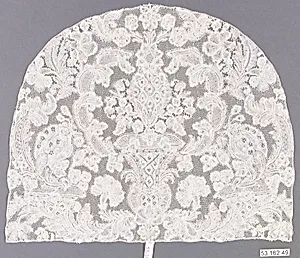
Cap crown
Unknown Artist
18th century
Medium
Bobbin lace, point d'Angleterre
Dimensions
H. 7 1/2 x W. 9 inches (19.1 x 22.9 cm)
Classification
Textiles-Laces
Culture
Flemish, Brussels
Department
European Sculpture and Decorative Arts
Museum
Metropolitan Museum of Art, New York, NY
Credit
Gift of Mrs. Albert Blum, 1953
Accession Number
53.162.49
Rights
Public Domain
Tags
Art Historical Context
This exquisite *Cap crown*, crafted in the 18th century by unknown Flemish artisan from Brussels, exemplifies the pinnacle of bobbin lace artistry. Measuring just 7½ by 9 inches, this delicate piece of point d'Angleterre lace—named after its popularity in England—was designed as an ornamental crown for women's caps, a fashionable accessory among Europe's elite. Its intricate floral motifs, a hallmark of Brussels lace, bloom in fine threads, showcasing the meticulous bobbin technique where pairs of threads are twisted and plied to create raised, sculptural patterns. Point d'Angleterre emerged in the late 17th century as a luxurious export from Brussels, rivaling French laces in prestige and adorning royal wardrobes from Versailles to English courts. This medium's significance lies in its technical virtuosity: lacemakers used hundreds of bobbins to weave dense, naturalistic flowers with a distinctive "bride" picot edge, blending functionality with opulence. As a textile from the heyday of Flemish lace production, it reflects the economic and cultural vibrancy of Brussels workshops, where guilds preserved centuries-old secrets. Today, this gift to the Metropolitan Museum of Art in 1953 invites us to marvel at lace's ephemeral beauty—once framing powdered wigs and silk gowns, now preserved as a testament to 18th-century craftsmanship.