
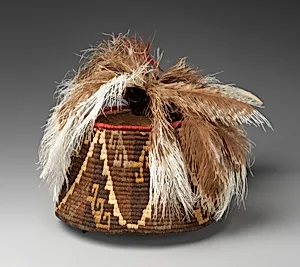
Cap with Feathers
Unknown Artist
10th–14th century
Medium
Wool, feathers
Dimensions
H. 4 1/8 x Diam. 6 in. (10.5 x 15.2 cm)
Classification
Textiles-Featherwork
Culture
Arica
Department
Arts of Africa, Oceania, and the Americas
Museum
Metropolitan Museum of Art, New York, NY
Credit
Bequest of Arthur M. Bullowa, 1993
Accession Number
1994.35.133
Rights
Public Domain
Art Historical Context
This exquisite "Cap with Feathers," by an unknown artist from the Arica between the 10th and 14th centuries, showcases the mastery of pre-Columbian featherwork in the Andean region. Measuring just 4 1/8 inches high and 6 inches in, this compact wool-based headdress is adorned with vibrant feathers, likely sourced from local or traded birds. Featherwork, classified as a textile art, was a labor-intensive technique where feathers were meticulously split, dyed, and woven or stitched onto a foundation fabric, creating shimmering, iridescent effects that symbolized prestige and spiritual power. Housed in the Metropolitan Museum of Art's Department of Arts of Africa, Oceania, and the Americas—thanks to the 1993 bequest of Arthur M. Bullowa—this cap offers a glimpse into Arica's rich cultural heritage along South America's arid northern Chilean coast. During this Intermediate Period, Arica communities thrived amid trade networks linking the Andes and Pacific, blending local wool weaving with exotic feather elements. Such caps were probably worn by elites in rituals or ceremonies, their lightweight yet durable form ideal for ceremonial use. Today, this rare survivor highlights featherwork's artistic innovation, where natural materials transformed everyday wool into objects of beauty and status, bridging utility and symbolism in pre-Columbian life.