
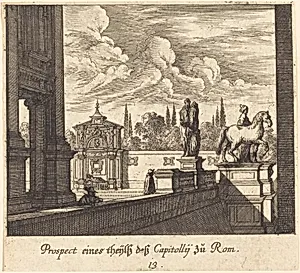
Capitoline, Rome
Medium
etching
Classification
Department
CG-E
Museum
National Gallery of Art, Washington, D.C.
Credit
Ailsa Mellon Bruce Fund
Accession Number
1975.23.22
Rights
Public Domain
Art Historical Context
Behold the majestic *Capitoline, Rome*, an exquisite 1681 etching by Melchiorsel, faithfully reproducing the design of Johann Wilhelm Baur. This print the iconic Capitoline Hill—one of Rome's ancient seven hills—at the heart of the Eternal City's civic and religious life. Home to the Temple of Jupiter Optimus Maximus in antiquity and later the Capitoline Museums, the hill symbolized Roman power and grandeur, drawing artists and travelers during the 17th century's burgeoning Grand Tour era. Küsel, a skilled German engraver known for his precise reproductive prints, employed etching techniques that allowed for fluid, expressive lines and rich tonal depth. Etching, popular in the Baroque period, enabled detailed topographical views like this one to be widely disseminated, bringing Rome's architectural splendor to collectors across Europe. Baur's original composition, with its dramatic perspective and intricate rendering of palaces, statues, and piazzas, reflects the era's fascination with classical antiquity amid the Counter-Reformation's cultural revival. Acquired through the Ailsa Mellon Bruce Fund and housed in the National Gallery of Art's Prints department (CG-E), this work offers a window into 17th-century visual culture, blending historical reverence with technical mastery. A testament to printmaking's role in preserving and popularizing heritage, it invites us to trace Rome's enduring legacy.