
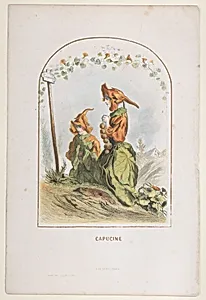
Capucine, from "Les Fleurs Animées"
Medium
Wood engravings and lithographs, hand-colored
Dimensions
Sheet: 10 5/16 × 6 15/16 in. (26.2 × 17.6 cm)
Classification
Prints
Department
Drawings and Prints
Museum
Metropolitan Museum of Art, New York, NY
Credit
The Elisha Whittelsey Collection, The Elisha Whittelsey Fund, 1960
Accession Number
60.628.49
Rights
Public Domain
Art Historical Context
"Capucine, from * Fleurs Animées*" is a delightful hand-colored print from a celebrated 19th-century French book author Alphonse Karr, with fantastical illustrations by the renowned caricaturist J.J. Grandville (Jean-Ignace-Isidore Gérard), alongside contributions from Taxile Delord, Gabriel de Gonet, Sarazin, and Charles-Michelroy. Published between the 1840s and spanning the broader 1820–70, the series whimsically anthropomorphizes flowers portraying the nasturtium (capucine) as a stylish, elegant woman amid blooming gardens. Grandville's signature style—blending sharp satire, Romantic fantasy, and meticulous detail—captures the era's fascination with nature's whimsy, turning botanical subjects into lively human characters. Crafted using wood engravings and lithographs, then meticulously hand-colored, this intimate sheet (10 5/16 × 6 15/16 in.) exemplifies mid-19th-century printing innovations. Wood engraving allowed for fine lines and textures ideal for floral intricacy, while lithography enabled subtle tonal gradients, and hand-coloring brought vibrant life to the pages—perfect for affordable yet luxurious illustrated books that bridged art and popular literature. Housed in the Metropolitan Museum of Art's Drawings and Prints department (Elisha Whittelsey Collection, 1960), this work highlights the cultural vogue for "floral personification," reflecting Romanticism's poetic view of nature amid industrialization. It's a charming window into how Victorians mingled science, humor, and beauty in everyday art.
About the Artist
Sarazin|Taxile Delord|Alphonse Karr|Gabriel de Gonet|J. J. Grandville|Charles-Michel Geoffroy (French) · 1592 –1660
French, Noyon 1592–1660 Paris