
Card table
Unknown Artist
ca. 1745–50
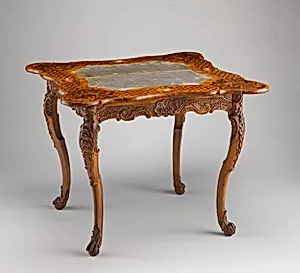
Medium
Carved walnut frame; pine top with marquetry of walnut, figured walnut, boxwood, alder burl, birch, olive wood, plum, padauk wood, yew, green-stained poplar, and other marquetry woods; lined with modern velvet; iron fittings
Dimensions
closed: 29 1/2 × 37 1/2 × 18 1/2 in. (74.9 × 95.3 × 47 cm)
Classification
Woodwork-Furniture
Culture
German, Bamberg
Department
European Sculpture and Decorative Arts
Museum
Metropolitan Museum of Art, New York, NY
Credit
The Lesley and Emma Sheafer Collection, Bequest of Emma A. Sheafer, 1973
Accession Number
1974.356.126
Rights
Public Domain
Art Historical Context
This elegant card table, crafted in Bamberg, Germany, around 1745–50, exemplifies the refined woodwork of mid-18th-century Central Europe. Foldable and compact when closed (29½ × 37½ × 18½ inches), was designed for aristocratic parlors, where games like ombre or whist fostered social bonds among the elite. Bamberg, a prosperous Franconian city, was renowned for its skilled cabinetmakers, who blended functionality with lavish ornamentation during the Rococo era's flourish. The table's standout feature is its pine top inlaid with intricate marquetry—a technique of cutting and fitting thin veneers of exotic woods to form pictorial designs. Here, artisans employed an astonishing array: walnut, figured walnut, boxwood, alder burl, birch, olive wood, plum, padauk, yew, green-stained poplar, and more, creating vibrant contrasts and likely floral or scenic motifs. A carved walnut frame, iron fittings, and modern velvet lining complete its luxurious appeal, showcasing the period's mastery of materials sourced from Europe and beyond. Housed in The Metropolitan Museum of Art's European Sculpture and Decorative Arts Department through the Lesley and Emma Sheafer Collection, this piece highlights Bamberg's contributions to furniture as high art. It invites us to imagine candlelit evenings of strategy and revelry, a testament to craftsmanship that elevated everyday leisure.