
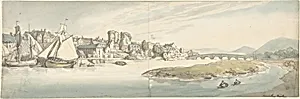
Carmarthen Castle, Wales
Medium
Watercolor, pen and ink
Dimensions
sheet: 5 5/8 x 17 in. (14.3 x 43.2 cm)
Classification
Drawings
Department
Drawings and Prints
Museum
Metropolitan Museum of Art, New York, NY
Credit
The Elisha Whittelsey Collection, The Elisha Whittelsey Fund, 1959
Accession Number
59.533.1659
Rights
Public Domain
Tags
Art Historical Context
Thomas Rowlandson's *Carmarthen Castle, Wales (1797) captures a picturesque riverside vista of this historic Welsh landmark through delicate watercolor, pen, and ink on a panoramic sheet measuring 5 5/8 x 17 inches. Created during the late 18th century, British artists like Rowlandson embraced topographical views amid growing Romantic fascination with dramatic landscapes and ancient ruins, this work reflects his travels across Britain. Known primarily for his satirical caricatures and lively social scenes, Rowlandson here showcases his skill in architectural detail and atmospheric rendering, blending precise ink lines with fluid washes to evoke the bustling life of a provincial town. The composition centers on Carmarthen Castle's imposing medieval towers rising above the winding River Towy, dotted with boats, bridges, and clustered buildings—a snapshot of everyday Welsh life in Georgian Britain. As a Norman fortress dating back to the 11th century, the castle symbolized centuries of conquest and defense, its weathered form adding a layer of historical romance to Rowlandson's scene. Housed in the Metropolitan Museum of Art's Drawings and Prints department, this piece from The Elisha Whittelsey Collection highlights the era's passion for documenting Britain's architectural heritage before industrialization transformed such sites. Rowlandson's technique—energetic pen strokes outlining structures against soft watercolor skies and water—brings vitality to the static landscape, inviting viewers to imagine the river's flow and townsfolk's rhythms. A charming window into 1790s Wales, it reminds us how art preserved vanishing vistas for future generations.
About the Artist
Thomas Rowlandson · 1756–1827
Thomas Rowlandson (1757–1827) was an English artist and caricaturist whose satirical watercolors and prints captured the social life of Georgian Britain with unparalleled wit and technical mastery. Alongside James Gillray, he is recognized as one of the greatest British graphic artists, and his distinctive flowing line and keen observations have made his work integral to understanding late 18th an...