
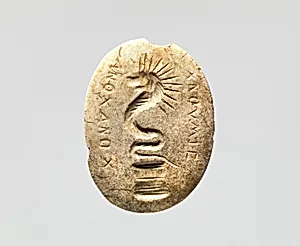
Carnelian intaglio: Lion-headed serpent
Unknown Artist
ca. 2nd–3rd century CE
Medium
Carnelian, burnt ?
Dimensions
Other: 15/16 x 3/4 x 3/16 in. (2.5 x 1.8 x 0.4 cm)
Classification
Gems
Culture & Period
Roman · Imperial
Department
Greek and Roman Art
Museum
Metropolitan Museum of Art, New York, NY
Credit
Gift of John Taylor Johnston, 1881
Accession Number
81.6.303
Rights
Public Domain
Tags
Art Historical Context
This exquisite carnelian intaglio, to the Roman Imperial period around the 2nd–3rd century CE, captures a fantastical lion-headed serpent in intricate detail. Carved from the vibrant red chalcedony known as carnelian—possibly heat-treated or "burnt" to intensify its warm hue—this tiny gem measures just 15/16 x 3/4 x 3/16 inches, perfect for mounting in a ring pendant. Such engraved stones prized in ancient Rome for their dual role as seals and personal talismans, impressing their incised image into wax for authentication or magical protection. The intaglio technique exemplifies Roman mastery of gem engraving, where artisans used fine tools to incise designs into hard stone, creating a sunken relief visible only in impressions. Carnelian's durability and blood-like color made it ideal for apotropaic gems, believed to ward off evil. The lion-headed serpent evokes chthonic mythology, blending leonine ferocity with serpentine symbolism of earth, rebirth, and guardianship—common motifs in Roman art influenced by Eastern traditions. A gift to the Metropolitan Museum of Art in 1881 from John Taylor Johnston, this piece offers a glimpse into everyday Roman spirituality, where myth met practicality in objects small enough to carry divine power. Visitors, imagine sealing a letter or invoking protection with such a jewel!