
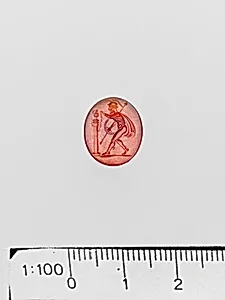
Carnelian ring stone
Unknown Artist
3rd–2nd century BCE
Medium
Carnelian
Dimensions
Length: 9/16 in. (1.4 cm)
Classification
Gems
Culture & Period
Italic · Hellenistic
Department
Greek and Roman Art
Museum
Metropolitan Museum of Art, New York, NY
Credit
Gift of John Taylor Johnston, 1881
Accession Number
81.6.24
Rights
Public Domain
Tags
Art Historical Context
This exquisite carnelian ring stone dating to the 3rd–2nd BCE, hails from Italic culture during the Hellenistic period—a time when Greek artistic influences blended with local Italian traditions. Carved from vibrant red carnelian, a durable semi-precious stone prized for its rich color and ability to hold fine engravings, this tiny gem measures just 9/16 inch (1.4 cm) long. Likely an intaglio designed to be set in a ring, it exemplifies the ancient craft of gem engraving, where artisans meticulously incised designs into hard stone for seals, jewelry, or talismans. The engraving depicts warriors armed with spears, capturing the martial spirit of Hellenistic Italic societies, possibly evoking heroic myths or real conflicts in pre-Roman Italy. Such gems were status symbols for elites, worn as personal emblems of power and prowess. The unknown artist's mastery of micro-scale detail highlights advanced lapidary techniques, using abrasives to create crisp lines that glow against the stone's translucent depth. Now housed in the Metropolitan Museum of Art's Greek and Roman Art Department (gift of John Taylor Johnston, 1881), this artifact offers a window into everyday luxury and cultural fusion in the ancient Mediterranean world.