
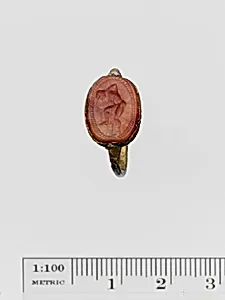
Carnelian scarab
Unknown Artist
late 6th century BCE
Medium
Carnelian, gold
Dimensions
Length: 1/2 in. (1.3 cm)
Classification
Gems|Gold and Silver
Culture & Period
Greek · Archaic
Department
Greek and Roman Art
Museum
Metropolitan Museum of Art, New York, NY
Credit
The Cesnola Collection, Purchased by subscription, 1874–76
Accession Number
74.51.4221
Rights
Public Domain
Tags
Art Historical Context
This exquisite carnelian scarab, dating to the late 6th century BCE exemplifies the artistry of Archaic Greece. Crafted from vibrant red-orange carnelian—a durable quartz prized for its rich color and fine grain—and accented with gold, this gem measures just 1/2 inch (1.3 cm) in length. As a seal, it would have been worn as jewelry or used to imprint wax or clay, authenticating documents or marking ownership in daily life. In the Archaic period, Greek artisans drew inspiration from Egyptian scarab forms, adapting them into elegant intaglio carvings. The scarab's beetle shape symbolized rebirth and protection, blending Eastern influences with emerging Greek naturalism. Techniques involved precise engraving to create a raised impression when stamped, showcasing the gem-cutters' mastery of hard stone on such a minuscule scale. Housed in the Metropolitan Museum of Art's Greek and Roman Art Department as part of the Cesnola Collection (acquired 1874–76), this scarab offers a window into ancient Mediterranean trade and cultural exchange. Visitors can marvel at how such a small object encapsulated power, status, and artistry over 2,500 years ago.