
Carpet
Unknown Artist
17th century
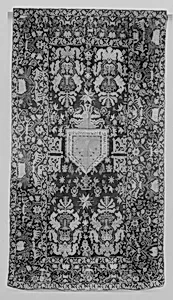
Medium
Linen warp and weft; wool pile, Ghiordes knot
Dimensions
206 x 114 in. (523.2 x 289.6 cm)
Classification
Textiles-Rugs
Culture
Spanish
Department
European Sculpture and Decorative Arts
Museum
Metropolitan Museum of Art, New York, NY
Credit
Gift of Mrs. William Randolph Hearst, 1964
Accession Number
64.169
Rights
Public Domain
Tags
Art Historical Context
This magnificent 17th-century Spanish carpet, measuring an impressive 206 x 114 inches, exemplifies the grandeur of Baroque-era textiles in Europe. Woven with a linen warp and weft and a dense wool pile using the Ghiordes knot—a symmetrical knotting technique typically associated with Anatolian rugs—this piece reflects the cross-cultural exchanges of the Spanish Golden Age. Produced during a time when Spain's global empire influenced its crafts, the carpet likely served as a status symbol in noble households, its vast scale ideal for covering grand palace floors or adorning walls. A standout feature is its central coat of arms, a heraldic emblem that underscores its aristocratic origins. Such motifs were common in Spanish rugs, symbolizing family lineage, royal favor, or regional pride amid the opulence of Habsburg courts. The Ghiordes knot ensured exceptional durability and intricate patterning, allowing weavers to create vivid, symmetrical designs that rivaled imported Oriental carpets flooding European markets. Generously gifted to the Metropolitan Museum of Art by Mrs. William Randolph Hearst in 1964, this anonymous masterpiece invites visitors to ponder the skilled hands behind Spain's textile legacy—artisans whose work bridged utility and artistry in an era of exploration and splendor.