
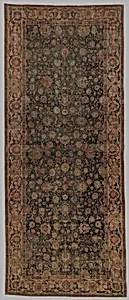
Carpet
Unknown Artist
late 16th century
Medium
Cotton (warp and weft), wool (pile); asymmetrically knotted pile
Dimensions
H. 288 3/4 in. (733.4 cm) W. 120 1/8 in (305.1 cm)
Classification
Textiles-Rugs
Department
Islamic Art
Museum
Metropolitan Museum of Art, New York, NY
Credit
Gift of Joseph V. McMullan, 1959
Accession Number
59.59
Rights
Public Domain
Art Historical Context
This magnificent late 16th-century carpet, hailing from the Islamic world, exemplifies the artistry of textile weaving during a golden age of carpet production. Measuring an impressive 24 feet long and over 10 feet wide, vast scale suggests it was designed to cover floors in grand palaces, mosques, or wealthy homes, serving both practical and decorative purposes. Crafted with a cotton warp and weft supporting a dense wool pile, the rug employs the asymmetrically knotted technique—also known as the Persian or Senneh knot—characteristic of high-quality Islamic carpets from regions like Persia (modern-day Iran). The asymmetrical knot allowed weavers to create intricate patterns with exceptional precision and density, a hallmark of technical mastery that distinguished these rugs in global trade. Produced anonymously by skilled artisans, such carpets were prized for their durability, vibrant dyes, and symbolic motifs, reflecting cultural values of hospitality, spirituality, and opulence in Safavid-era society. Today, this rare survivor graces the Metropolitan Museum of Art's Islamic Art department, a generous 1959 gift from Joseph V. McMullan, inviting visitors to marvel at the enduring legacy of nomadic and urban weaving traditions.