
Carpet
Unknown Artist
early 17th century
Medium
Cotton (warp and weft), wool (weft and pile); asymmetrically knotted pile
Dimensions
L. 241 in. (612.1 cm) W. 98 1/4 in. (249.6 cm)
Classification
Textiles-Rugs
Department
Islamic Art
Museum
Metropolitan Museum of Art, New York, NY
Credit
Gift of Mrs. Harry Payne Bingham, 1959
Accession Number
59.75
Rights
Public Domain
Art Historical Context
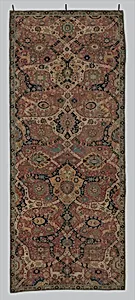
This magnificent early 17th-century, hailing from the Islamic world, exemplifies the exquisite textile artistry of the Safavid era in Persia (modern-day Iran). Woven with cotton warps and wefts, and a lush wool weft and pile it measures an impressive 241 inches long 98¼ inches wide—large enough to anchor a grand room in a palace or mosque. Its asymmetrically knotted pile technique known as the Persian or Senneh knot, allowed weavers to create intricate, densely packed patterns with remarkable precision and durability, a hallmark of high-end Islamic rug production. The asymmetric knotting not only ensured the carpet's longevity but also enabled the fluid, curvilinear designs typical of Persian rugs, often featuring floral motifs, medallions, or arabesques symbolizing paradise gardens. Produced during a golden age of Islamic art under Shah Abbas I, such carpets were prized luxury goods, traded across Europe and the Ottoman Empire, blending functionality with spiritual and aesthetic depth. A generous gift to the Metropolitan Museum of Art from Mrs. Harry Payne Bingham in 1959, this anonymous masterpiece invites us to marvel at the anonymous skill of its makers, preserving a slice of 17th-century splendor for modern eyes.