
Carpet Fragment
Unknown Artist
last quarter 16th century
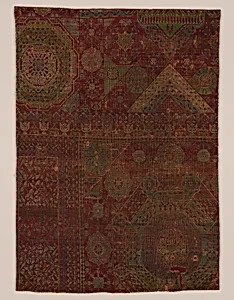
Medium
Wool (warp, weft, and pile); asymmetrically knotted pile
Dimensions
H. 77 1/2 in. (196.9 cm) W. 55 1/2 in. (141 cm)
Classification
Textiles-Rugs
Department
Islamic Art
Museum
Metropolitan Museum of Art, New York, NY
Credit
Gift of Joseph V. McMullan, 1971
Accession Number
1971.263.1
Rights
Public Domain
Art Historical Context
This exquisite carpet fragment, dating to the last quarter of the16th century, hails from the Islamic world and exemplifies the pinnacle of textile artistry during the Safavid era in Persia. Measuring an impressive 77½ by 55½ inches, it once formed part of a larger floor covering, likely used in grand homes, mosques, or palaces to add warmth, luxury, and symbolic beauty to interiors. Though the artist remains unknown, such fragments reveal the anonymous mastery of weavers whose works influenced global design for centuries. Crafted entirely from wool—for warp, weft, and pile—the carpet employs the asymmetrically knotted pile technique, a hallmark of Persian rug-making. This method, also known as the Senneh knot, allows for finer detail and denser patterns than symmetric knotting, enabling intricate motifs like florals, medallions, or geometric designs that conveyed cultural motifs of paradise gardens or spiritual harmony. The durability of wool ensured these pieces endured, surviving wars and trade routes to reach us today. Now housed in the Metropolitan Museum of Art's Department of Islamic Art, this fragment was generously gifted by Joseph V. McMullan in 1971. It invites visitors to ponder the skilled hands behind Islamic textile traditions, where every knot wove stories of innovation, faith, and opulence into fabric.