
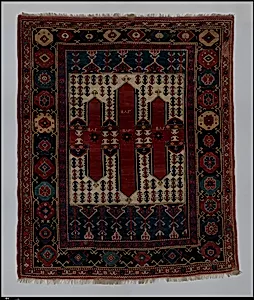
Carpet with Double-Ended Triple Niche
Unknown Artist
dated A.H. 1182/ 1768–69 CE
Medium
Wool (warp, weft, and pile); symmetrically knotted pile
Dimensions
H. 81 in. (205.7 cm) W. 66 in. (167.6 cm)
Classification
Textiles-Rugs
Department
Islamic Art
Museum
Metropolitan Museum of Art, New York, NY
Credit
Bequest of Joseph V. McMullan, 1973
Accession Number
1974.149.20
Rights
Public Domain
Art Historical Context
This stunning *Carpet with Double-Ended Triple N*, dated A.H. 1182 (1768–69 CE), exemplifies the exquisite textile artistry of the Islamic world during the late 18th century. woven in Anatolia or a neighboring region under Ottoman influence, its design features three prayer-niche (mihrab) arches repeated symmetrically at both ends, the rug to be used reversibly for prayer—a practical and spiritually resonant adaptation. Such motifs evoke the sacred architecture of mosques, transforming a humble floor covering into a portable sanctuary for the faithful. Crafted entirely from wool for the warp, weft, and pile using the symmetrically knotted technique (also known as the Turkish knot), the carpet measures an impressive 81 by 66 inches, ideal for communal or individual use. This labor-intensive method, involving over a million knots, ensured durability and a plush texture while enabling intricate patterns that have endured for centuries. The precise dating inscribed on the rug highlights the weavers' pride in their craft, a hallmark of high-quality Islamic carpets. Now housed in the Metropolitan Museum of Art's Department of Islamic Art, thanks to the bequest of collector Joseph V. McMullan in 1973, this piece offers a window into everyday devotion and masterful craftsmanship. Visitors can appreciate how such rugs bridged utility and beauty in Ottoman-era homes and mosques.