
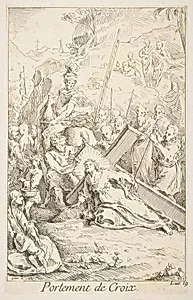
Carrying the Cross
Medium
Etching
Dimensions
image: 7 5/8 x 4 13/16 in. (19.4 x 12.3 cm), trimmed to image
Classification
Prints
Department
Drawings and Prints
Museum
Metropolitan Museum of Art, New York, NY
Credit
Rogers Fund, 1962
Accession Number
62.602.476
Rights
Public Domain
Tags
Art Historical Context
"Carrying the Cross" a striking etching attributed to Claude Gillot and Jacques Gabriel Huquier, two prominent French artists of the early 18th century. Gill, a painter and engraver known for his lively scenes and influence on the Rococo style—he mentored Antoine Watteau—collaborated or inspired works like this with Huquier, a skilled reproductive engraver. Created around this undatable period (n.d.), the print captures a pivotal moment from the Passion of Christ: Jesus burdened by the cross, flanked by Roman soldiers and figures, evoking the raw drama of the Crucifixion narrative. Etching, the medium here, involves coating a metal plate with acid-resistant ground, scratching designs into it, and immersing it in acid to etch lines of varying depth. This technique allowed Gillot and Huquier to achieve intricate, expressive details in the 7 5/8 x 4 13/16-inch image, now trimmed neatly to its borders for display. The composition's dynamic tension—Christ's weary determination amid the soldiers' stern presence—highlights the print's role in disseminating religious imagery during an era when such scenes educated and inspired the faithful. Housed in the Metropolitan Museum of Art's Drawings and Prints department (acquired via Rogers Fund, 1962), this work exemplifies how prints democratized art, making sacred stories accessible beyond grand canvases. Visitors will appreciate its emotional depth and technical finesse, a window into Baroque-era devotion.
About the Artist
Claude Gillot|Jacques Gabriel Huquier · 1673–1722
Artist known for his elegant designs done in the Rococo manner of Audran; also for his predilection for scenes from the 'comedia dell'arte.' Few paintings survive; his work is known mainly through drawings and etchings. Comment on works: Genre; History